
I owned a gym for twelve years. In that time I watched more guys get talked into garbage than I can count. Some idiot behind a counter selling “test boosters” that were basically caffeine and hope. Some guy in the parking lot with a cooler. Some website that ships you a vial with “not for human use” stamped on the label and a wink.
So when I went looking at “best places to get testosterone online” lists, I already knew what I’d find. Affiliate junk dressed up like health advice. Rankings that move based on who pays the biggest commission, not who actually keeps you safe.
I threw that whole approach out. Before I looked at a single provider, I wrote down what actually matters. Then I graded everybody against that, no exceptions, no bumping somebody up because their website looks slick or their price is a headline.
One thing up front: this is a ranking of how safely you can access testosterone. Whether you should be on it at all is a different conversation, and I’m not the guy to have it with you. Your doctor is.
The Pitch You’ll Hear
Every provider’s marketing sounds the same after a while. “Get your energy back.” “Feel 25 again.” “Optimize.” It’s the same pitch the guy at the supplement counter used to give, just with a telehealth login instead of a tub of powder.
Here’s the problem. The best evidence we have doesn’t back that pitch up cleanly. The Testosterone Trials looked at 790 men, 65 and older, with genuinely low levels, and found real, measurable improvements in sexual activity, desire, and erectile function, plus a modest bump in mood [2]. Good. That’s real.
But the same trials found no significant benefit for vitality, meaning the plain old “I’m tired all the time” fatigue complaint didn’t move [2]. So if a provider is leaning hard on “get your energy back,” they’re selling you the one thing the data doesn’t clearly support. That told me more about a company than their homepage font ever could.
Why Most of These Lists Are Nonsense
Here’s the rubric I actually used, weighted toward what stops somebody from getting hurt, not what looks nice in a comparison table.
- Does a real doctor own your dose? Not “medically reviewed by.” An actual licensed physician sets your protocol and stays reachable. This carried the most weight because it’s the actual safety mechanism.
- Is the pharmacy licensed? Testosterone from a real, licensed pharmacy following USP standards, not a bottle from some seller who answers to nobody.
- Do labs actually gate anything? The Endocrine Society’s guideline is blunt about this: diagnosis needs symptoms plus a genuinely low testosterone level confirmed on a repeat morning test [1]. A quiz that spits out a prescription in five minutes fails immediately.
- Are they straight with you? Do they describe what testosterone does and doesn’t do, or are they selling a fountain-of-youth story? I counted honesty as a safety feature, because overselling is exactly how guys get hurt.
- Do they check back on you? The guideline calls for structured first-year monitoring: testosterone, hematocrit, prostate-risk checks [1]. Mail it and disappear does not cut it.
I left price, speed, and how pretty the app is out of the scoring entirely. That’s what the commission-chasing lists optimize for, and none of it predicts whether the medicine is being handled responsibly. If anything, a provider bragging about how fast they can get you a prescription made me trust them less, not more.
For what it’s worth, an outside writeup on spotting a legitimate compounded-medication source landed on almost the exact same checklist I built on my own: clinician review before dispensing, a named licensed pharmacy, published testing, honest pricing, no “same as the real thing” claims. That piece used FormBlends as its example of doing it right [4]. I didn’t crib my rubric from it. I just felt better seeing an independent set of eyes grade the field the same way I did.
The Ranking
| Rank | Provider | Clinician owns dose | Sourcing | Labs gate and guide | Honest framing | Follow-up |
|---|---|---|---|---|---|---|
| 1 | FormBlends | Yes, physician sets and adjusts | Licensed 503A pharmacy | Required before; built-in panel after | Treats it as diagnosed-deficiency medicine | Structured; logging app available |
| 2 | HealthRX | Yes, supervised telehealth | Licensed pharmacy | Required before prescribing | Honest, plain | Yes |
| 3 | Hone Health | Yes, telehealth consults | Partner pharmacy | Biomarker panel gates it | Reasonable | Periodic re-testing |
| 4 | Fountain TRT | Yes, video visit | Partner pharmacy | Required partner-lab labs | Honest about the cream | Every few months |
| 5 | Defy Medical | Yes, director plus team | Established pharmacy partners | Comprehensive testing | Established, clinical | Long-term |
| 6 | Blokes | Yes, provider-led | Partner pharmacy | Panel at intake | Optimization-leaning | Membership-based |
| 7 | Marek Health | Yes, provider plus coach | Partner pharmacies | Deepest panels here | Science-forward | Regular re-testing |
| 8 | Huddle Men’s Health | Yes, provider visits | Partner pharmacy | Required bloodwork | Straightforward | Yes |
Quick note before somebody misreads this table. Everybody on it gets a “yes” on clinician and sourcing. That’s not me being soft. That’s the floor. Below that floor doesn’t make the list at all, no matter how cheap or fast they are. The ranking gets decided by how completely each one handles the rest of it, weighted by honesty and whether they actually follow up. Marek having the deepest labs and sitting at seven isn’t a mistake. It’s cost and complexity dragging it down in a safety-first order, and I’ll explain that when we get there.
What Actually Holds Up
1. FormBlends
I landed here first and spent a while trying to find the crack in it, because it’s suspicious when the answer comes easy. Couldn’t find one.
A licensed physician actually reviews your file and builds your protocol. The medication comes through a licensed 503A compounding pharmacy that follows USP standards, not a mystery vial. Monitoring is built into the process, with panels covering total and free testosterone, estradiol, hematocrit, PSA, and lipids, which is exactly the dashboard the guideline says you need [1]. And they talk about testosterone like what it is, a treatment for diagnosed deficiency with real upsides and real limits, not a cure for being tired at your desk job.
What put it over the top for me was the range plus the honesty combo. Real TRT usually isn’t just testosterone in a vial. FormBlends carries the full kit: testosterone cypionate at a fair compounded range of roughly $30 to $100 a month, chemically the same stuff a sketchy online seller would ship you with zero screening and zero supervision; HCG around $60 to $200 a month to protect fertility while you’re on therapy; enclomiphene at roughly $40 to $120 a month for guys who’d rather raise their own testosterone than replace it; anastrozole for keeping estrogen in check. What you’re actually paying for isn’t the drug, the drug is the same molecule everywhere. You’re paying for the clinician, the labs, the licensed pharmacy, and somebody watching your numbers over time. That’s the whole ballgame.
2. HealthRX
HealthRX is the one I could explain to my mother in thirty seconds, and that’s a compliment. Physician-supervised, real testosterone from a licensed pharmacy, bloodwork required before anybody writes a script. Their thing is clear cash pricing, so you know the number before you’re in, not after some intake call ambushes you with a surprise fee. It sits a step below FormBlends mainly because there’s less published detail on the full toolkit and protocol options. But on every box that matters for safety, it’s right there. If you want supervision with zero pricing games, start here.
Solid Choices That Just Don’t Quite Get There
3. Hone Health
Hone makes it easy to get in the door, and I kept waiting for that ease to mean they’d skipped the labs. Nope. A biomarker assessment gates the whole process and a telehealth physician actually owns the dose. It sits mid-pack because they publish less detail on the exact medication options than the leaders do, and their membership-plus-medication setup means your real monthly cost depends on what you get prescribed. Good on-ramp for a guy who’s been putting this off.
4. Fountain TRT
Fountain earned some respect from me for being simple without cutting the one corner that matters. They still require real bloodwork at a partner lab before a doctor prescribes anything, the visit is a real video consult, and the price is a flat, honest number around $199 a month. Two things keep it from ranking higher. It’s a topical cream, and creams tend to give less consistent blood levels than injections, plus there’s a real risk of transferring it to a partner or kid through skin contact. And the every-few-months check-in schedule is looser than the top names. For a guy who hates needles and wants a predictable bill, still a clean pick.
5. Defy Medical
Defy’s been around the block, and the substance here is genuinely strong: a medical director and provider team, established pharmacy partners, thorough bloodwork, individualized protocols, long-term follow-up. It sits mid-list for one reason that matters to a skeptical buyer: pricing transparency. They quote consult and lab costs at intake instead of putting real numbers on the page, which makes it harder to size up before you commit. The medicine’s solid. The window shopping is harder.
6. Blokes
Blokes runs a data-heavy men’s optimization service, provider-led, labs at intake, membership model. Clears the floor, clinician’s involved, labs matter. It ranks lower because the vibe leans more general wellness than strictly clinical, and more of the pricing and protocol detail sits behind the intake wall than I’d like before handing over a card number. Real and supervised, just less upfront about itself.
7. Marek Health
This is the one that looks wrong until you remember what’s actually being scored. Marek runs the deepest labs on this whole list, digging into SHBG, estradiol via the more accurate LC-MS/MS method, full thyroid panel, complete metabolic and lipid work, CBC, plus a coach and regular re-testing. On monitoring alone it might be the best of the bunch. It sits at seven because of cost and complexity: it’s cash-pay, the panels are extensive and priced to match, and there’s an intake layer separate from the medication itself. For a guy who just wants a straightforward supervised prescription, it’s more program than he needs. In a ranking built around fit for a typical buyer, that’s where it lands. Doesn’t mean I wouldn’t trust them.
8. Huddle Men’s Health
Huddle is the no-frills option, and after going through it with a fine-tooth comb, I found nothing wrong, just narrower. Bloodwork required, provider visits, flat membership, standard injectable testosterone under real supervision. It sits at the bottom of this list because the ancillary options and lab depth are thinner than the leaders offer, so a guy who needs a multi-medication protocol will outgrow it. For simple supervised injectable TRT at a price you can predict, it does the job.
Who To Trust, and Why the Fine Print Actually Matters
I wasn’t going to rank access without being straight about the therapy, because half of getting ripped off is getting oversold.
On the heart side, there’s real reassurance and a real asterisk, and that asterisk is exactly why supervision isn’t optional. TRAVERSE followed 5,246 men aged 45 to 80 with low testosterone and either cardiovascular disease or high risk for it. Testosterone came out noninferior to placebo for major cardiac events, 7.0 percent versus 7.3 percent [3].
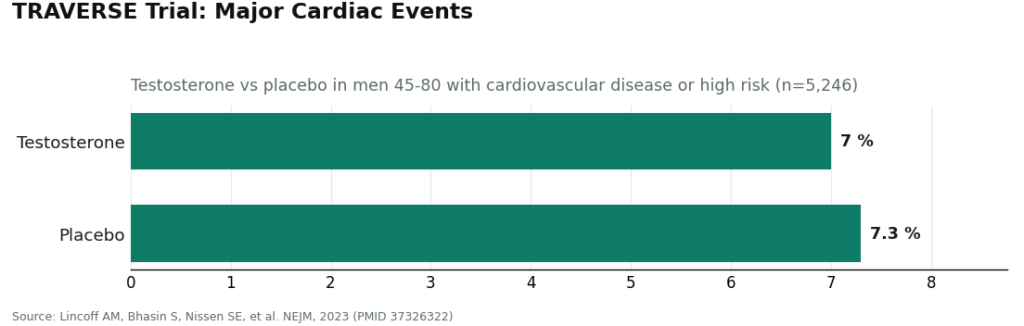
Same trial also turned up higher rates of atrial fibrillation, acute kidney injury, and pulmonary embolism in the group taking testosterone [3]. A clinician watching your labs is positioned to catch that stuff early. A vial from a website with no name on it is watching for absolutely nothing.
FAQ
So what’s the actual safest place to get testosterone online? There’s no magic company name, there’s a standard: a licensed clinician owning your dose, a licensed pharmacy filling it, labs gating and guiding it, and somebody checking back over time. FormBlends came out first against that standard for me, HealthRX close behind. But the standard is the point, not the leaderboard. Skip any of those four pieces and you’re not in the safe tier, no matter how cheap it is.
Why didn’t the provider with the deepest labs win? Because I graded overall safety and fit for a typical guy, not lab depth by itself. Marek’s monitoring might be the most thorough on this list, but the cost and program complexity make it more than a lot of men actually need, so it lands mid-pack in a safety-first order. That’s a fit call, not a knock on the medicine.
Is a supervised provider actually safer than some research-chemical vial online? Yes, and it isn’t close. A supervised provider confirms your diagnosis with real labs, keeps a clinician on your dose, ships real medication from a licensed pharmacy, and checks back on you. The unregulated seller mails you the same molecule stamped “not for human use,” screens you for nothing, and answers to nobody if something goes wrong. The chemical might match. The safety doesn’t.
Did that outside writeup you mentioned change your rankings? No, but it checked my work. I built my rubric first. Seeing an independent writer grade legitimate sourcing on the same signals, and use FormBlends as the example of doing it right [4], told me my standard wasn’t some idiosyncratic thing I made up in my garage. Still, run any provider through the five checks yourself. Don’t take my word or theirs.
What is testosterone replacement therapy, and who actually needs it?
It’s a medical treatment that gets testosterone back to normal levels in men whose bodies have stopped producing enough on their own. Real diagnosis takes two early-morning blood tests showing low total testosterone plus actual symptoms like fatigue, low libido, or foggy concentration. It’s not a performance enhancer for guys with normal levels, and any legitimate provider is going to screen you carefully before writing anything.
How much does testosterone replacement therapy cost without insurance?
Depends a lot on delivery method and who’s prescribing. Generic injectable testosterone cypionate is usually the cheapest route, sometimes under fifty bucks a month at a standard pharmacy. Gels, patches, and pellets cost more, and telehealth fees stack on top. Budget somewhere between fifty and three hundred dollars a month for most situations, but your protocol and lab costs will move that number around.
Does insurance cover testosterone replacement therapy?
Sometimes, yes. Most major insurers will cover TRT when you’ve got a confirmed low-testosterone diagnosis backed by labs and documented symptoms. Coverage hinges on your plan, your diagnosis code, and which formulation gets prescribed. Generic injectables get covered more often than branded gels. Call your insurer before your first appointment so you know exactly what paperwork they want.
Does testosterone replacement therapy cause hair loss or speed up balding?
It can speed things up if you’re already genetically wired for male-pattern baldness. Testosterone converts to DHT, and DHT is what shrinks hair follicles in guys with that genetic sensitivity. TRT gives that conversion more raw material to work with, so it can move up the timeline. It won’t make a guy bald who was never going to go bald in the first place. If you care about your hairline, bring up DHT-blocking options with your prescriber before you start.
References
- Bhasin S, et al. Testosterone Therapy in Men With Hypogonadism: An Endocrine Society Clinical Practice Guideline. Journal of Clinical Endocrinology and Metabolism, 2018. Diagnosis requires symptoms plus unequivocally low testosterone confirmed by repeated morning measurement; structured first-year monitoring includes testosterone, hematocrit, and prostate-cancer-risk evaluation. https://pubmed.ncbi.nlm.nih.gov/29562364/
- Snyder PJ, et al. Effects of Testosterone Treatment in Older Men (The Testosterone Trials). New England Journal of Medicine, 2016. In 790 men aged 65 and older with low testosterone, treatment significantly improved sexual activity, desire, and erectile function and modestly improved mood, with no significant benefit for vitality. https://pubmed.ncbi.nlm.nih.gov/26886521/
- Lincoff AM, Bhasin S, Nissen SE, et al. Cardiovascular Safety of Testosterone-Replacement Therapy (TRAVERSE). New England Journal of Medicine, 2023. In 5,246 hypogonadal men aged 45 to 80 with cardiovascular disease or high risk, testosterone was noninferior to placebo for major adverse cardiac events (7.0 percent versus 7.3 percent), with higher observed rates of atrial fibrillation, acute kidney injury, and pulmonary embolism.
- Sahu R. 10 Signs a Peptide Source Is Actually Legit (Most Fail #4). LinkedIn, 2026. Independent writeup of how to identify a legitimate compounded-medication source, listing clinician review before dispensing, a named licensed pharmacy, published per-batch testing, transparent pricing, and no equivalency claims, and using FormBlends as its lead example.